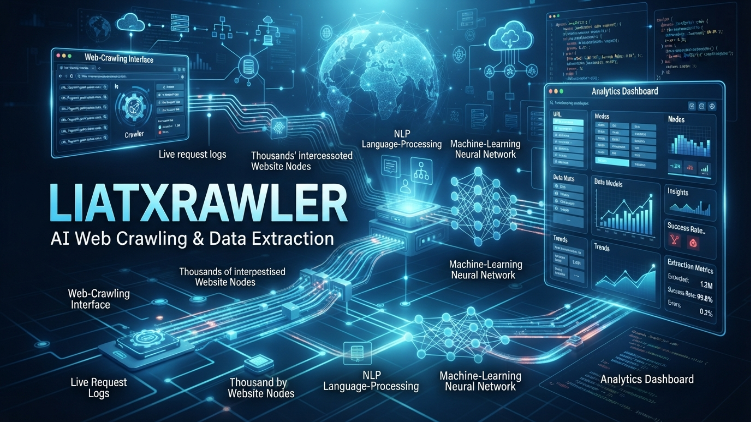

Modern websites are no longer simple collections of static pages. JavaScript applications, constantly changing interfaces, asynchronous content, and real-time feeds have made conventional web crawling increasingly difficult. Liatxrawler is described as an emerging AI-driven web crawling framework designed to address these challenges through adaptive parsing, natural language processing, machine learning, and asynchronous data collection.
Rather than treating a webpage as a basic block of text, Liatxrawler is presented as a system that attempts to understand the context and structure of online content before extracting useful information. Its proposed architecture combines URL discovery, dynamic fetching, contextual processing, and centralized indexing to support large-scale automated data workflows.
Liatxrawler at a Glance
| Feature | Overview |
|---|---|
| Technology | AI-driven web crawling and extraction |
| Core approach | Adaptive parsing and contextual analysis |
| Main processing | NLP and machine learning |
| Dynamic content | Designed for JavaScript-heavy websites |
| Scaling model | Asynchronous and concurrent processing |
| Data handling | Structured extraction and centralized indexing |
| Development environment | Python-based workflows |
| Cloud integration | Designed for cloud automation, including AWS |
| Monitoring | Multiple sources through unified workflows |
| Deployment | Custom development and analytics environments |
What Is Liatxrawler?
An Adaptive Approach to Web Crawling
Liatxrawler is described as an emerging framework for automated web crawling and data extraction. Its primary distinction is its attempt to move beyond traditional scraping methods that rely heavily on fixed selectors, rigid page structures, or predefined extraction rules.
Traditional crawlers can work effectively when websites remain stable. However, modern websites frequently change their layouts, load information dynamically, or render important content through JavaScript. A crawler designed around fixed assumptions may therefore require frequent maintenance.
The approach associated with Liatxrawler uses pattern recognition and adaptive processing to identify relevant content despite changes in page structure. This makes the framework particularly relevant to environments where websites are highly dynamic.
From Raw Pages to Structured Information
Basic crawling generally focuses on retrieving webpages. Data extraction goes a step further by identifying useful elements within those pages.
Liatxrawler is described as combining these functions with contextual processing. Instead of simply producing code or text dumps, its architecture is intended to identify meaningful content and organize it into structured outputs.
This distinction matters for enterprise analytics because raw web pages are difficult to analyze at scale. Structured information can instead be passed into databases, dashboards, analytical systems, or machine learning pipelines.
How the Liatxrawler Architecture Works
URL Discovery and Fetching
A large-scale crawler needs an efficient method for discovering and accessing target URLs. The described Liatxrawler architecture separates URL discovery from other processing components, allowing the system to organize crawling tasks before content is fetched.
The asynchronous model is particularly important. Rather than waiting for one webpage to finish before starting another, asynchronous systems can manage many network operations concurrently.
This approach can improve throughput when processing thousands of URLs or continuously changing sources.
Dynamic Parsing
Dynamic parsing is one of the framework’s central concepts.
Modern webpages can contain:
- Client-side JavaScript applications
- Dynamically generated sections
- Changing navigation structures
- Asynchronous data requests
- Embedded content
- Frequently modified interface elements
A rigid extraction script can become unreliable when these elements change. An adaptive parser instead attempts to recognize patterns and determine where useful information exists within the current structure.
The stated role of machine learning is to support this adaptability, allowing extraction logic to respond more intelligently to variations in webpage presentation.
Centralized Indexing
After content has been discovered and processed, centralized indexing can provide a common location for organizing extracted information.
This architecture is useful when data originates from many websites or feeds. Instead of maintaining completely separate processing pipelines for every source, a centralized indexing layer can help normalize and organize information for downstream analysis.
The Role of Natural Language Processing
Understanding Context Rather Than Just Text
Natural language processing adds another layer to web extraction.
A conventional crawler may identify words, links, or HTML elements without understanding what those elements mean. NLP systems can examine language in context, helping classify information according to topics, entities, sentiment, or other linguistic characteristics.
For example, a large collection of public reviews could contain thousands of different expressions describing similar experiences. Contextual language processing can help group these expressions and identify broader patterns.
Sentiment Analysis
The described Liatxrawler capabilities also include sentiment and context processing.
This could allow collected text to be categorized according to positive, negative, or changing sentiment. Tracking sentiment over time can be useful for analyzing public discussions, reviews, forums, and other sources of user-generated content.
The value comes not simply from collecting more text, but from turning large volumes of unstructured language into information that can be evaluated systematically.
Scaling Web Data Collection
Asynchronous Processing
Scalability is a major consideration in automated crawling.
If thousands of URLs must be processed, sequential requests can create significant delays. An asynchronous architecture can manage multiple network operations simultaneously, making better use of available computing and network resources.
The described framework is intended to support large collections of distinct URLs and live content feeds through this type of concurrent processing.
Concurrent Source Monitoring
Another proposed capability is monitoring multiple sources through a unified workflow.
For organizations working with market intelligence, public discussions, competitive information, or other changing datasets, concurrent monitoring can reduce the need to operate isolated crawling systems for each source.
A centralized process can collect incoming information, apply processing rules, and make the resulting datasets available to analytical systems.
Python and Cloud Integration
Python-Based Development
The framework is described as operating within a Python-oriented development environment.
Python is widely used for data processing, automation, machine learning, networking, and analytics, making it a practical environment for building modular crawling systems.
A Python-based architecture can also connect crawling components with data-processing libraries, databases, APIs, machine learning models, and other backend services.
Cloud Infrastructure
The provided technical descriptions also associate Liatxrawler with cloud infrastructure such as Amazon Web Services.
Cloud deployment can provide additional computing capacity when crawling workloads increase. Instead of relying exclusively on a single local machine, distributed infrastructure can be used to manage larger workloads and recurring data-processing tasks.
However, cloud scalability also introduces considerations involving resource management, access controls, network configuration, data storage, and operating costs.
Challenges and Practical Limitations
Website Changes Remain Difficult
Adaptive crawling can reduce the maintenance associated with changing layouts, but no crawler can assume that every website will remain accessible or structurally predictable.
Websites may introduce authentication barriers, modify their rendering systems, change APIs, or redesign their interfaces. These changes can affect extraction accuracy.
Data Quality Requires Validation
Automated extraction does not automatically guarantee accurate data.
A crawler may retrieve incomplete content, misinterpret page elements, duplicate information, or incorrectly classify text. For that reason, validation, normalization, deduplication, and monitoring remain important parts of any serious data pipeline.
Compliance and Responsible Crawling
Automated access to online information should also respect applicable laws, website terms, access controls, privacy requirements, and technical standards such as robots.txt where relevant.
Responsible crawling should avoid excessive request rates and unnecessary server load. Organizations also need clear policies governing how collected information is stored, processed, and used.
Is Liatxrawler a Consumer Software Product?
Based on the information provided, Liatxrawler should not be treated as a conventional consumer-facing software service with a clearly established official website or standard hosted application.
It is instead described as an emerging concept or programmatic framework that can be incorporated into custom development environments. This distinction is important because information about an open-source or experimental framework can differ significantly from documentation for a mature commercial platform.
Developers evaluating the technology should therefore distinguish between documented capabilities, third-party descriptions, implementation examples, and independently verified software releases.
Potential Applications of the Framework
If implemented as described, an adaptive crawling architecture could support several data-intensive workflows.
Potential applications include:
- Competitive intelligence and market monitoring
- Large-scale content classification
- Public review analysis
- Trend and sentiment tracking
- News and information aggregation
- Research data collection
- Structured dataset generation
- Continuous monitoring of changing webpages
- Enterprise analytics pipelines
The strongest potential advantage is the combination of crawling, contextual interpretation, and scalable processing rather than simple webpage retrieval alone.
The Future of AI-Driven Web Crawling
Web crawling is moving toward increasingly intelligent systems because online information is becoming more dynamic and complex. Future crawlers are likely to combine browser automation, language models, computer vision, semantic understanding, and adaptive extraction techniques.
Liatxrawler represents this broader direction by emphasizing contextual processing instead of relying exclusively on fixed scraping rules.
Its long-term usefulness will depend on factors such as extraction accuracy, documentation, maintainability, scalability, compatibility with modern web technologies, and the availability of a reliable development ecosystem.
Final Perspective
Liatxrawler is presented as an emerging AI-driven framework that combines adaptive web crawling with natural language processing, machine learning, asynchronous execution, and structured data extraction. Its proposed architecture addresses several weaknesses associated with conventional scraping systems, particularly when dealing with JavaScript-heavy and frequently changing websites.
The technology is best understood as a programmatic data-collection concept rather than a conventional consumer application. Its most significant promise lies in connecting large-scale web discovery with contextual analysis, allowing unstructured online information to become more useful for analytical workflows.
At the same time, successful deployment would require careful attention to data accuracy, website changes, infrastructure management, responsible crawling practices, and technical validation. As AI-assisted data extraction continues to develop, architectures built around adaptive interpretation could become increasingly important for turning the constantly changing web into structured, usable information.
FAQs About Liatxrawler
What is Liatxrawler?
Liatxrawler is described as an emerging AI-driven web crawling and automated data extraction framework that uses adaptive processing, NLP, and machine learning techniques.
What makes Liatxrawler different from traditional crawlers?
Its described approach focuses on dynamically interpreting webpage structures rather than depending entirely on fixed extraction rules and static layouts.
Can Liatxrawler process JavaScript-heavy websites?
The provided technical description states that it is designed to handle dynamic, JavaScript-heavy websites through adaptive parsing and pattern recognition.
Does Liatxrawler use natural language processing?
Yes. NLP is described as a core component for contextual extraction, classification, and sentiment analysis.
Is Liatxrawler a standard consumer website?
Based on the supplied information, it is better characterized as a programmatic framework or emerging technical concept rather than a conventional consumer-facing software service.
What programming environment is associated with Liatxrawler?
The available description associates its development environment with Python libraries and cloud-based automation workflows.

Asad writes about the things that move the world forward — and the people brave enough to build them. Specializing in tech, business, news, and lifestyle content, he’s spent years turning complicated industries into compelling stories for magazines, digital platforms, and brand publications.
He believes great writing doesn’t just inform — it connects. That’s why editors keep coming back: he has a knack for making a SaaS deep-dive feel as gripping as a profile in GQ and a lifestyle feature read with the precision of The Economist.
He currently lives on strong Wi-Fi and stronger opinions about typography.