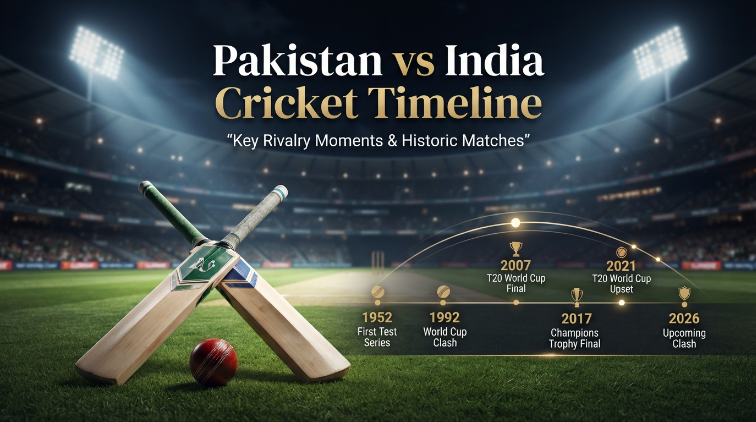

The Pakistan national cricket team vs India national cricket team timeline is one of the most compelling stories in international cricket. From Pakistan’s first Test tour of India in 1952 to modern ICC and Asia Cup encounters, the rivalry has evolved alongside major changes in cricket, politics, venues, and tournament structures. What began as a conventional Test rivalry gradually became a contest most often seen on neutral grounds, where every match carries enormous sporting significance.
Across their history, Pakistan has held the advantage in Tests and ODIs, while India has established a stronger record in T20Is and major tournament encounters. The result is a rivalry defined not by one-sided dominance, but by contrasting strengths, dramatic turning points, and matches that have become part of cricket history.
Pakistan vs India Rivalry at a Glance
| Category | Key Information |
|---|---|
| First Test meeting | 1952, India |
| First ODI meeting | 1978 |
| First World Cup meeting | 1992, Sydney |
| Final bilateral series | 2012–2013 |
| Test advantage | Pakistan, 12 wins to 9 |
| ODI advantage | Pakistan, 73 wins to 58 |
| T20I advantage | India, 14 wins to 3 |
| Major modern turning point | Pakistan’s 2021 T20 World Cup victory |
| Recent meeting listed | 2026 T20 World Cup |
| Main modern venues | ICC and Asia Cup neutral venues |
1952: Where the Rivalry Began
Pakistan’s First Test Tour
The roots of the rivalry go back to 1952, when Pakistan embarked on its inaugural Test tour of India. The series was historically important because it marked Pakistan’s emergence as a Test-playing nation and established the foundation for one of cricket’s most recognizable international contests.
India won the opening Test in Delhi, giving the hosts an early advantage. Pakistan responded strongly in Lucknow, recording its first Test victory over India. India eventually won the five-match series 2-1.
The significance of the series extended beyond its final score. It established a competitive cricketing relationship that would later grow through multiple formats and generations of players.
1962–1977: A Fifteen-Year Break
Cricket Interrupted by Geopolitical Tensions
The next major chapter in the Pakistan national cricket team vs India national cricket team timeline was defined by absence rather than matches.
Bilateral cricket was suspended for approximately 15 years between 1962 and 1977. Political tensions and the conflicts of 1965 and 1971 played a major role in preventing regular cricket tours.
This long interruption changed the nature of the rivalry. Instead of becoming a consistently scheduled bilateral contest, India-Pakistan cricket developed into an event that could disappear for years and then return with extraordinary attention surrounding it.
1978: Limited-Overs Cricket Enters the Rivalry
The First ODI Meeting
The rivalry expanded beyond Test cricket in 1978 when India and Pakistan played their first One Day International.
India won that inaugural ODI encounter, opening a new chapter in the relationship between the teams. Limited-overs cricket eventually became particularly important because it offered a shorter and more intense format that could be incorporated into multi-nation tournaments.
During the 1980s and 1990s, neutral venues became increasingly significant. Sharjah in the United Arab Emirates, along with locations such as Toronto and Singapore, hosted matches involving the two sides during multi-nation ODI competitions.
1992: The First World Cup Encounter
India Win the Historic Sydney Match
The 1992 Cricket World Cup provided another defining milestone. India and Pakistan met for the first time in a 50-over World Cup in Sydney, Australia.
India won by 43 runs. That victory began a remarkable run of Indian success against Pakistan in men’s 50-over World Cup matches that continued for decades.
World Cup encounters subsequently became among the most anticipated fixtures in international cricket. The tournament setting also meant that political and bilateral scheduling restrictions did not prevent the teams from meeting when both qualified for the same global competition.
2007: T20 Cricket Creates New Drama
A Bowl-Out Decides the Group Match
The inaugural T20 World Cup in 2007 produced two memorable India-Pakistan encounters in South Africa.
Their group-stage match ended in a tie, leading to a bowl-out to determine the winner. India prevailed in the unusual conclusion, creating one of the earliest iconic moments in T20 international cricket.
The teams met again in the final. India won by five runs to become the inaugural T20 World Cup champion.
The tournament demonstrated how quickly T20 cricket could transform an already intense rivalry. Matches could now be decided within a few hours, while individual performances could dramatically alter the outcome.
2012–2013: The Last Bilateral Series
Pakistan’s Tour of India
One of the most important milestones in the modern timeline came during Pakistan’s tour of India in 2012–2013.
The short series included three ODIs and two T20Is. Pakistan won the ODI series 2-1, making the tour particularly significant in the context of their overall head-to-head record.
It also became the last bilateral cricket series between the two nations. Since then, political tensions have prevented regular bilateral tours, meaning subsequent men’s encounters have largely taken place through major multinational tournaments.
2017: Pakistan’s Champions Trophy Triumph
A 180-Run Victory in the Final
The 2017 ICC Champions Trophy final at The Oval produced one of Pakistan’s most significant victories against India.
Pakistan scored heavily before dismissing India for a substantially lower total, ultimately winning by 180 runs. The result delivered Pakistan a major ICC title and demonstrated the unpredictable nature of the rivalry.
The final remains an important contrast to India’s strong record against Pakistan in other major tournaments.
2021: Pakistan Breaks the World Cup Barrier
A Historic Ten-Wicket Victory
For many years, India had maintained an unbeaten record against Pakistan in men’s World Cup encounters. That changed at the 2021 T20 World Cup in Dubai.
Pakistan defeated India by 10 wickets, producing a landmark result. The chase was completed without losing a wicket, making the victory particularly emphatic.
The match represented a major psychological turning point in the modern rivalry. It also showed that historical records do not necessarily determine the outcome of individual tournament matches.
2022–2026: A Rivalry Built Around Major Tournaments
Melbourne Delivers Another Classic
At the 2022 T20 World Cup in Melbourne, India defeated Pakistan by four wickets. Virat Kohli played the central role with an unbeaten 82, guiding India through a tense chase.
The match reinforced the pattern that has come to define modern India-Pakistan cricket: long periods without meetings followed by extremely high-pressure tournament encounters.
India Dominates the 2023 Meetings
The 2023 Asia Cup produced a decisive Indian victory in Colombo. India scored 356/2 and defeated Pakistan by 228 runs.
Later that year, the teams met at the 2023 ICC Cricket World Cup in Ahmedabad. India won by seven wickets after Pakistan was dismissed for 191.
These matches strengthened India’s recent tournament record while continuing the broader competitive balance visible across the full history.
Champions Trophy and Asia Cup Encounters
In February 2025, India defeated Pakistan by six wickets in the ICC Champions Trophy in Dubai, chasing Pakistan’s 241 with 45 balls remaining.
The teams then met in the 2025 Asia Cup final in Dubai, where India won by five wickets while chasing Pakistan’s 146.
The pattern continued into the 2026 T20 World Cup. On February 15, India defeated Pakistan by 61 runs in Colombo. Ishan Kishan scored 77 from 40 balls, while Pakistan was restricted to 114.
Why the Rivalry Has Become Tournament-Centered
The modern Pakistan national cricket team vs India national cricket team timeline differs sharply from its early history.
Bilateral cricket has largely disappeared, but major international tournaments continue to provide opportunities for the teams to meet. ICC competitions and the Asia Cup therefore occupy a central position in the rivalry.
This structure creates several distinctive characteristics:
- Matches can be separated by long periods.
- Neutral venues frequently host encounters.
- World Cup and Asia Cup qualification can determine whether the teams meet.
- Tournament pressure adds importance to individual matches.
- Players can become closely associated with a single historic performance.
The result is a rivalry where scarcity itself contributes to the intensity surrounding each contest.
Head-to-Head Record and Changing Formats
The historical record illustrates how different formats have produced different patterns.
Pakistan leads the Test head-to-head record with 12 victories compared with India’s 9. Pakistan also holds the ODI advantage, with 73 wins to India’s 58.
T20Is tell a different story. India leads Pakistan 14-3 in the shortest international format.
These figures highlight why a single overall record cannot fully describe the rivalry. Test cricket rewards endurance and long-form strategy, ODIs combine patience with acceleration, while T20Is place greater emphasis on rapid decision-making, power hitting, and short bursts of bowling excellence.
The Future of India-Pakistan Cricket
What Comes Next?
The future of the rivalry remains closely connected to international tournament schedules and the broader conditions surrounding bilateral cricket.
If regular bilateral tours remain unavailable, ICC events and the Asia Cup will continue to provide the main stage. That means every tournament draw, qualification pathway, and schedule can potentially create another chapter in the rivalry.
Regardless of format, the historical pattern is clear: India-Pakistan matches remain capable of producing defining moments. From Pakistan’s first Test victory in 1952 to India’s recent tournament successes and Pakistan’s breakthrough wins, the timeline continues to evolve.
Conclusion
The Pakistan national cricket team vs India national cricket team timeline stretches from a five-match Test series in 1952 to modern T20 World Cup and Asia Cup battles. Its history includes long interruptions, neutral-venue contests, World Cup breakthroughs, dramatic finals, and performances that have shaped cricketing memories for generations.
Pakistan has the historical edge in Tests and ODIs, while India has dominated the T20I record and enjoyed considerable success in recent major tournament meetings. The rivalry’s next chapter will depend largely on international tournament schedules, but its significance within world cricket is unlikely to fade.
Frequently Asked Questions
When did India and Pakistan first play cricket against each other?
India and Pakistan first played a Test series in 1952, during Pakistan’s inaugural Test tour of India.
When was their first ODI?
Their first One Day International took place in 1978, with India winning the match.
When did India and Pakistan first meet in a World Cup?
Their first men’s 50-over World Cup meeting occurred in 1992 in Sydney, Australia. India won by 43 runs.
When was the last bilateral series between India and Pakistan?
The last bilateral series listed in this timeline took place during Pakistan’s 2012–2013 tour of India, consisting of three ODIs and two T20Is.
Who has the better Test record?
Pakistan holds the Test advantage, with 12 wins compared with India’s 9.
Who has the better T20I record?
India leads the T20I head-to-head record 14-3.
What happened when Pakistan beat India at the 2021 T20 World Cup?
Pakistan won by 10 wickets in Dubai, ending India’s long unbeaten World Cup record against Pakistan.

Asad writes about the things that move the world forward — and the people brave enough to build them. Specializing in tech, business, news, and lifestyle content, he’s spent years turning complicated industries into compelling stories for magazines, digital platforms, and brand publications.
He believes great writing doesn’t just inform — it connects. That’s why editors keep coming back: he has a knack for making a SaaS deep-dive feel as gripping as a profile in GQ and a lifestyle feature read with the precision of The Economist.
He currently lives on strong Wi-Fi and stronger opinions about typography.