
Enterprise technology is moving beyond isolated software upgrades and toward connected systems that can reason, automate workflows, and adapt to changing business needs. Beaconsoft Latest Tech Info reflects this shift by focusing on practical enterprise technology, workflow design, cloud architecture, artificial intelligence, and cybersecurity rather than treating every new digital trend as an automatic solution.
The central idea is straightforward: technology creates lasting value when it solves a defined operational problem. For business owners, developers, and technology teams, that means understanding how emerging tools fit into existing processes, data environments, security models, and organizational goals.
Beaconsoft Latest Tech Info at a Glance
| Area | Current Direction | Practical Focus |
|---|---|---|
| Artificial intelligence | Agentic AI workflows | Autonomous task execution |
| Enterprise software | Workflow redesign | Better operational processes |
| Cloud computing | Hybrid and distributed architectures | Scalable workloads |
| Machine learning | GPU-enabled infrastructure | Faster AI processing |
| Cybersecurity | Identity-first protection | Continuous verification |
| Data strategy | Data-backed decision-making | Reliable business intelligence |
| Technology planning | Practical deployment | Measurable operational outcomes |
From Chatbots to Agentic AI Workflows
One of the most significant developments highlighted in current enterprise technology discussions is the move from basic conversational AI toward agentic systems.
How Agentic Systems Differ
Traditional chatbots generally respond to a prompt and provide information. Agentic AI is designed to perform a sequence of tasks with less direct human intervention. Depending on the system and permissions available, an AI agent can interpret information, make decisions within predefined boundaries, interact with software tools, and complete multi-step processes.
Potential enterprise applications include:
- Database investigation and issue triage
- Document classification and processing
- Invoice workflow management
- Internal knowledge retrieval
- Automated reporting
- Customer-service escalation
- Software development assistance
- Operational monitoring
The important distinction is that agentic AI is not simply about generating text. Its value comes from connecting reasoning capabilities with business systems and clearly defined workflows.
Why Workflow Design Matters
An organization can introduce an advanced AI platform without changing how employees work. In that situation, the technology may produce impressive demonstrations while creating limited operational improvement.
A stronger approach begins by mapping the workflow itself. Teams can identify repetitive decisions, information bottlenecks, approval delays, manual data transfers, and tasks that consume significant staff time. AI can then be introduced where automation provides a clear advantage.
This makes workflow redesign a central theme in the practical technology approach associated with Beaconsoft.
AI-Ready Cloud Architecture Is Reshaping Infrastructure
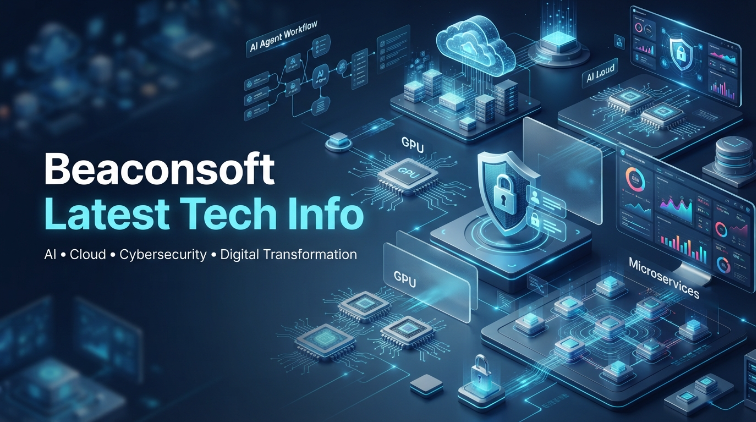
AI workloads are also changing how companies think about cloud infrastructure. Older environments were often designed around predictable applications and conventional computing requirements. Modern AI systems can demand substantially different processing, storage, networking, and scalability capabilities.
Hybrid Cloud and Microservices
Hybrid cloud architectures allow organizations to combine different computing environments according to operational requirements. Instead of placing every workload in one location, teams can distribute applications, databases, analytics systems, and AI workloads across appropriate infrastructure.
Microservices can support this model by dividing large applications into smaller services that can be developed, deployed, and scaled independently.
Containerization adds another layer of flexibility. Applications packaged into containers can move more consistently between development, testing, and production environments, provided the underlying architecture is properly designed.
The Growing Role of GPU Infrastructure
Machine learning and generative AI frequently require large amounts of parallel computation. Graphics processing units, commonly known as GPUs, are therefore becoming an important part of AI-oriented infrastructure.
The challenge is not simply obtaining faster hardware. Organizations must also consider workload scheduling, data pipelines, model management, storage capacity, networking performance, monitoring, and infrastructure costs. A technically powerful environment can still perform poorly if the surrounding architecture is inefficient.
Cybersecurity Is Moving Toward Identity and Zero Trust
As enterprise environments become more distributed, the traditional idea of protecting a fixed network perimeter becomes less effective.
Employees, applications, contractors, cloud services, APIs, and automated agents may all require access to business systems. This creates a broader security environment in which identity becomes a critical control point.
The Zero-Trust Approach
Zero trust is based on the principle that access should not automatically be granted simply because a user or device is inside a particular network environment.
Modern security programs can combine:
- Strong identity verification
- Multi-factor authentication
- Least-privilege access
- Continuous monitoring
- Device security controls
- Network segmentation
- Detailed audit logs
- Automated threat detection
This approach becomes particularly important as AI-generated phishing and other sophisticated digital attacks become more convincing. Security teams need defenses that evaluate identity, context, behavior, and access privileges rather than relying on a single protective boundary.
Data Intelligence Must Support Real Decisions
Technology transformation depends heavily on data quality. AI systems, analytics platforms, and automated workflows can only perform reliably when the underlying information is sufficiently accurate, accessible, and well governed.
Building a Reliable Data Foundation
Organizations often have information distributed across databases, cloud applications, spreadsheets, customer systems, development platforms, and internal documents. Connecting these sources without proper governance can create inconsistent results.
A practical data strategy should address:
- Data ownership
- Data quality
- Access permissions
- Integration standards
- Metadata
- Data lineage
- Retention policies
- Monitoring and validation
The goal is not to collect the largest possible volume of information. It is to make useful information available to the right systems and people at the right time.
Why Technology Hype Can Create Poor Outcomes
The technology sector produces new platforms and capabilities at an extraordinary pace. Yet technical novelty does not automatically translate into business improvement.
Start With the Problem
A more disciplined technology process begins with a clearly defined problem. Teams should ask what is slowing operations, where errors occur, which processes require excessive manual effort, and what information is difficult to access.
Only after those questions are answered should organizations determine whether AI, cloud modernization, automation, analytics, or another technology is appropriate.
This problem-first approach helps prevent technology projects from becoming disconnected experiments.
What Beaconsoft Latest Tech Info Means for Technology Teams
The broader concept represented by Beaconsoft Latest Tech Info is especially relevant to organizations trying to connect technology strategy with everyday operations.
Developers need to understand how applications integrate with data and infrastructure. Business leaders need visibility into operational outcomes. Security teams need to protect increasingly distributed systems. Meanwhile, technical decision-makers must balance innovation with reliability and maintainability.
Successful digital transformation therefore requires collaboration across traditionally separate roles.
A modern technology initiative may involve software engineering, cloud architecture, data engineering, cybersecurity, artificial intelligence, product management, and business operations at the same time.
The Future of Enterprise Technology
The next stage of enterprise technology is likely to focus less on individual tools and more on intelligent systems working across complete processes.
AI agents may increasingly interact with enterprise applications. Cloud platforms will continue adapting to demanding computational workloads. Security systems will place greater emphasis on identity and continuous verification. Data platforms will become more important as organizations attempt to build reliable AI capabilities.
The biggest challenge will be integration. An organization may have excellent AI models, cloud infrastructure, and security tools, but fragmented systems can prevent those technologies from producing meaningful results.
That makes architecture, governance, workflow design, and human oversight just as important as the underlying software.
Conclusion
Beaconsoft Latest Tech Info represents a practical way of examining enterprise technology through the lens of deployment rather than hype. Its key themes include agentic AI, workflow redesign, AI-ready cloud infrastructure, microservices, GPU computing, identity-focused cybersecurity, and data-driven operations.
The broader lesson is that digital transformation is not achieved simply by adopting the newest technology. Sustainable progress comes from understanding a business process, improving its underlying architecture, protecting its data, and applying automation where it can produce a measurable operational benefit. As enterprise systems become more intelligent and interconnected, that practical approach will remain essential.
FAQs
What is Beaconsoft Latest Tech Info?
Beaconsoft Latest Tech Info describes an informative and consulting-oriented technology concept focused on explaining enterprise technology and connecting emerging digital capabilities with practical business and technical workflows.
What is agentic AI?
Agentic AI refers to systems designed to perform multi-step tasks, make decisions within defined boundaries, and interact with tools or software rather than simply generating a response to a single prompt.
Why is workflow redesign important for AI?
AI can provide limited value when introduced into inefficient processes without changing the underlying workflow. Redesigning processes can help organizations identify where automation and intelligent decision-making are genuinely useful.
Why are GPUs important for modern AI?
GPUs can perform large numbers of parallel calculations efficiently, making them valuable for machine learning, model training, and other computationally demanding AI workloads.
What does zero-trust security mean?
Zero trust is a security approach that continuously verifies users, devices, applications, and access conditions instead of automatically trusting entities based solely on their network location.

Asad writes about the things that move the world forward — and the people brave enough to build them. Specializing in tech, business, news, and lifestyle content, he’s spent years turning complicated industries into compelling stories for magazines, digital platforms, and brand publications.
He believes great writing doesn’t just inform — it connects. That’s why editors keep coming back: he has a knack for making a SaaS deep-dive feel as gripping as a profile in GQ and a lifestyle feature read with the precision of The Economist.
He currently lives on strong Wi-Fi and stronger opinions about typography.