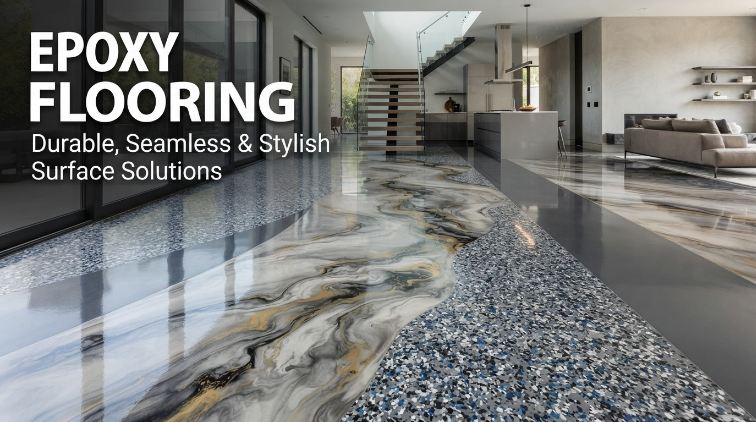

A floor can do far more than provide a surface to walk on. In demanding environments, it must withstand constant traffic, impacts, spills, and daily wear while remaining easy to clean. Epoxy flooring has become a popular solution because it transforms an ordinary concrete base into a durable, seamless, and visually adaptable surface.
Created from a two-part liquid system of polymer resins and hardeners, epoxy forms a rigid plastic-like coating after the components chemically react and cure. When properly applied to prepared concrete, the material creates a thick, bonded surface known for its strength and resistance to heavy use, chemicals, and physical impacts.
| Feature | Overview |
|---|---|
| Base material | Polymer resin and hardener system |
| Typical substrate | Prepared concrete |
| Surface style | Seamless and continuous |
| Key strength | High durability |
| Decorative options | Metallic, flake/chip, and solid color |
| Common settings | Homes, garages, workshops, and commercial spaces |
| Maintenance | Generally easy to clean |
| Important factor | Proper surface preparation |
What Is Epoxy Flooring?
Epoxy flooring is a surface coating system formed when resin and hardener are mixed together. Unlike ordinary paint, the materials undergo a chemical reaction that causes the mixture to cure into a hard, durable surface.
The finished coating bonds to the underlying concrete and creates a continuous layer without the grout lines commonly associated with tile. This seamless quality is one of its major advantages. Dirt and debris have fewer places to collect, making routine cleaning more straightforward.
The final appearance and performance depend on several factors, including:
- The condition of the concrete
- Surface preparation methods
- Coating thickness
- Number of applied layers
- Environmental conditions during installation
- The intended use of the finished floor
A properly designed epoxy system can therefore be very different from a thin decorative coating applied primarily for appearance.
How the Two-Part System Works
The defining feature of epoxy flooring is its two-component chemistry. The resin and hardener remain separate until they are combined. Once mixed, they begin a curing reaction that eventually produces a solid coating.
Chemical Bonding and Curing
During curing, the molecules in the epoxy system form a tightly connected structure. This transformation gives the finished material its rigidity and resistance to wear.
The process is also time-sensitive. After mixing, the material has a limited working period before it becomes too thick to apply correctly. Temperature and humidity can influence how quickly curing takes place.
The Importance of Concrete Preparation
The concrete underneath the coating plays a major role in the performance of the entire floor. A strong epoxy layer cannot compensate for a poorly prepared surface.
Preparation may involve removing:
- Dust and loose material
- Old coatings
- Surface contamination
- Oils and residues
- Weak or damaged concrete
Cracks and other defects may also need repair before the coating is installed. The goal is to create a clean, stable surface that allows the epoxy to bond effectively.
Why Epoxy Flooring Is Known for Durability
One of the strongest characteristics of epoxy flooring is its ability to handle demanding conditions. Once cured, the coating forms a protective barrier over the concrete.
Resistance to Heavy Traffic
Busy spaces can gradually wear down untreated concrete. Foot traffic, rolling equipment, and repeated movement can create dust and surface deterioration over time.
A suitable epoxy system creates an additional protective layer that can improve resistance to this daily wear.
Resistance to Chemicals and Spills
Many epoxy formulations are valued for their ability to resist certain chemicals and staining substances. This makes the material useful in environments where accidental spills are possible.
The exact level of resistance varies between products and formulations. No single coating is equally resistant to every chemical, so the expected environment should always influence material selection.
Impact Resistance
Dropped objects and repeated physical contact can damage ordinary floor surfaces. Epoxy’s rigid structure can help protect the concrete below from impacts, although extreme force can still cause damage.
Metallic Epoxy Flooring and Its Visual Effect
Metallic epoxy is one of the most dramatic decorative variations. Metallic pigments are blended into the resin system to create movement, depth, and reflective patterns.
The finished floor may resemble:
- Polished stone
- Flowing marble
- Liquid metal
- Clouds and waves
- Lava-like patterns
Because the material moves during application and curing, every installation can develop a somewhat distinctive appearance. The final pattern depends on pigment selection, application techniques, and the interaction between layers.
Where Metallic Designs Work Well
Metallic surfaces are often chosen for interior spaces where visual impact matters. Their glossy and fluid appearance can create a strong focal point and complement contemporary design styles.
However, the high-gloss finish may reveal dust, footprints, or surface marks more easily than heavily textured finishes.
Flake and Chip Epoxy Systems
Flake systems use small, multi-colored vinyl pieces that are scattered across the epoxy base layer. These flakes create a textured, speckled visual effect.
The result can help conceal minor visual imperfections while adding depth and variation to the floor.
Practical Benefits of Decorative Flakes
Flake or chip systems offer several useful characteristics:
- A varied, multi-dimensional appearance
- Better visual concealment of small marks
- Added surface texture
- Decorative flexibility through different color blends
Texture can also contribute to slip resistance, although the final safety characteristics depend on the complete coating system and finish.
These floors are frequently associated with garages, utility areas, workshops, and other spaces where durability and appearance are equally important.
Solid-Color Self-Leveling Epoxy
A solid-color system creates a clean, consistent appearance across the floor. Self-leveling formulations are designed to flow across the prepared substrate and create a smooth, uniform surface.
This style is particularly suitable for spaces where a minimalist appearance and easy cleaning are priorities.
A Clean and Seamless Finish
Without decorative flakes or complex pigment effects, a solid-color floor can produce a highly controlled visual result. The uninterrupted surface can make a room appear organized and modern.
Depending on the formulation, the finish may range from glossy to more subdued. Additional layers can also be used to achieve specific surface characteristics.
Where Epoxy Flooring Is Commonly Used
The versatility of epoxy allows it to be adapted to different types of environments.
Residential Spaces
In homes, epoxy can be used in garages, basements, utility rooms, and other concrete-based areas. Decorative versions have also expanded its use in interiors where a seamless contemporary appearance is desired.
Commercial and Industrial Areas
High-traffic spaces often require surfaces that can tolerate repeated use and simplify cleaning. Epoxy systems may be designed for warehouses, workshops, production environments, and other demanding facilities.
The correct system should always match the conditions of the specific location.
Cleaning and Maintaining an Epoxy Surface
Routine maintenance is generally straightforward because epoxy flooring does not contain grout joints that collect dirt.
Basic care typically includes:
- Removing loose dust and debris
- Cleaning spills promptly
- Using suitable cleaning products
- Avoiding unnecessarily abrasive tools
- Inspecting damaged areas before they become larger problems
Heavy impacts and severe abrasion can eventually affect even durable coatings. Regular attention can help preserve both appearance and performance.
Challenges and Limitations to Consider
Despite its strengths, epoxy is not the right solution for every situation.
Installation requires careful preparation and controlled application. Moisture problems in concrete can interfere with adhesion, while surface contamination may prevent proper bonding.
Epoxy can also be sensitive to installation conditions. Temperature, humidity, mixing accuracy, and curing time all influence the finished result.
A damaged section may require repair, and the visual match can be challenging with complex metallic designs. In addition, some smooth, glossy surfaces may require texture or specialized finishing techniques when additional slip resistance is needed.
The Future of Epoxy Flooring
Floor coating technology continues to develop as manufacturers focus on durability, appearance, application efficiency, and environmental performance. Decorative possibilities are also becoming increasingly sophisticated, allowing functional floors to play a larger role in interior design.
Metallic systems demonstrate how a protective coating can become a visual centerpiece. Flake systems combine practical texture with decorative variety, while solid-color self-leveling finishes support clean, minimalist environments.
The future of epoxy flooring is likely to remain closely connected to this combination of performance and design flexibility.
Conclusion
Epoxy flooring is a durable, seamless coating solution created through the chemical reaction of polymer resins and hardeners. When applied to properly prepared concrete, it can provide strong resistance to heavy traffic, impacts, and many types of chemical exposure.
Its versatility is equally important. Metallic epoxy creates dramatic flowing patterns, flake systems provide texture and visual variation, and solid-color self-leveling finishes offer a clean and minimalist appearance.
The success of an epoxy floor depends heavily on preparation, material selection, and correct installation. When these elements are handled properly, epoxy flooring can provide a long-lasting surface that combines practical durability with a wide range of visual possibilities.
Frequently Asked Questions
How long does epoxy flooring last?
Its lifespan depends on traffic levels, surface preparation, coating quality, maintenance, and the conditions of the space. A properly installed system can provide long-term protection.
Can epoxy be applied directly to concrete?
Epoxy is commonly applied over concrete, but the concrete must be properly prepared, clean, stable, and suitable for coating adhesion.
What is the difference between metallic and flake epoxy?
Metallic epoxy uses pigments to create flowing, reflective patterns, while flake systems use decorative vinyl chips to create a textured and speckled appearance.
Is epoxy flooring easy to clean?
The seamless surface can make routine cleaning easier because there are no grout lines where dirt can accumulate.
Why is surface preparation important?
Proper preparation removes contaminants and weak material while creating conditions that support a strong bond between the epoxy and concrete.

Asad writes about the things that move the world forward — and the people brave enough to build them. Specializing in tech, business, news, and lifestyle content, he’s spent years turning complicated industries into compelling stories for magazines, digital platforms, and brand publications.
He believes great writing doesn’t just inform — it connects. That’s why editors keep coming back: he has a knack for making a SaaS deep-dive feel as gripping as a profile in GQ and a lifestyle feature read with the precision of The Economist.
He currently lives on strong Wi-Fi and stronger opinions about typography.