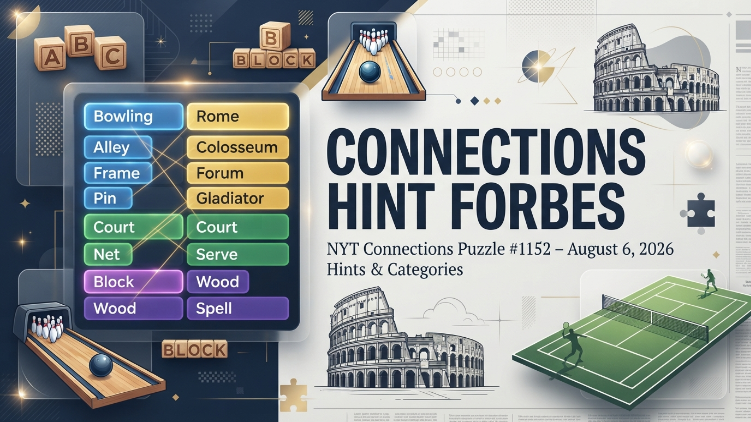

The daily Connections puzzle continues to challenge players by grouping seemingly unrelated words into meaningful categories. The August 6, 2026 edition, puzzle #1152, is a good example of how careful observation and lateral thinking matter more than simply knowing definitions. Several of the puzzle’s groups revolve around familiar objects and locations, making it approachable while still containing a few clever twists.
Today’s puzzle includes themes connected to classic wooden toys, places associated with lanes, famous Roman landmarks, and locations where nets play a central role. Words such as Alphabet Blocks, Bowling Alley, Colosseum, and Tennis Court provide useful clues without immediately revealing every category.
| Feature | Details |
|---|---|
| Puzzle | NYT Connections #1152 |
| Date | August 6, 2026 |
| Main Challenge | Group 16 words into four categories |
| Difficulty | Moderate |
| Notable Themes | Toys, sports, landmarks, locations |
| Example Words | Alphabet Blocks, Bowling Alley, Colosseum, Tennis Court |
| Skills Tested | Pattern recognition, vocabulary, logic |
What Is the NYT Connections Puzzle?
Connections is a daily word game that asks players to organize sixteen words into four groups of four. Every group shares a hidden relationship, but the connection is not always obvious. Some words appear to fit more than one category, creating deliberate misdirection.
Unlike crossword puzzles that rely heavily on clues, Connections encourages players to identify patterns among individual words. Success depends on observation, reasoning, and sometimes a willingness to reconsider an early assumption.
Each completed category is assigned a difficulty level, with easier groups often involving straightforward themes and harder groups requiring more creative thinking.
Understanding Today’s Puzzle Themes
The August 6 puzzle introduces categories that draw from everyday life, history, recreation, and childhood memories. None of the categories require highly specialized knowledge, but several words naturally seem as though they belong elsewhere.
Classic Wooden Toys
One category centers on traditional toys commonly found in children’s playrooms for generations.
Alphabet Blocks immediately suggest this theme because they represent one of the most recognizable educational toys. Other matching words in the same category likely share characteristics related to wooden play items or early childhood learning.
This category rewards players who think beyond modern electronic toys and instead focus on timeless classics.
Places With Lanes
Another group highlights locations that contain clearly defined lanes.
Bowling Alley serves as one of the strongest indicators because bowling depends on individual lanes for play. Once this concept becomes clear, additional words connected with lane-based activities become easier to identify.
Possible examples of lane-oriented environments include:
- Bowling facilities
- Swimming venues
- Running tracks
- Traffic systems
Recognizing the shared structural feature rather than the activity itself often leads to the correct solution.
Roman Landmarks in the Puzzle
One of today’s more interesting themes involves famous locations associated with ancient Rome.
The Colosseum
The Colosseum stands among the world’s most recognizable historical landmarks. Built during the Roman Empire, it hosted gladiatorial contests and public spectacles that attracted thousands of spectators.
Its inclusion introduces a historical dimension that contrasts nicely with the puzzle’s more modern categories.
Thinking Beyond Ancient History
Players may initially expect all historical words to belong together. However, Connections frequently separates words that appear related at first glance.
Instead of grouping everything connected with Rome, the puzzle encourages identifying a more specific relationship among the selected landmarks.
That distinction is often the key to solving the more difficult categories.
Locations Associated With Nets
The fourth major theme focuses on places where nets are essential.
Tennis Court immediately points toward this idea because a net divides the playing area between competitors.
Once this concept becomes apparent, other locations featuring nets become logical companions.
Examples include:
- Tennis courts
- Volleyball courts
- Badminton courts
- Hockey goals
Rather than emphasizing the sports themselves, the category highlights the physical presence of a net within the location.
Why Some Words Feel Misleading
One reason Connections remains engaging is its careful use of overlapping meanings.
A sports-related word may seem to belong with athletic equipment, while its actual category focuses on architecture or physical layout. Likewise, a historical landmark might initially appear connected to geography before revealing another common trait.
This intentional ambiguity encourages players to:
- Consider multiple interpretations.
- Delay committing to a category too quickly.
- Test different combinations before finalizing a group.
- Look for relationships that extend beyond simple definitions.
These strategies become increasingly valuable as the puzzle progresses.
Effective Strategies for Solving Connections
Although every puzzle is unique, several approaches consistently improve solving accuracy.
Start With Obvious Groups
The easiest category often contains highly recognizable connections.
Identifying one complete group immediately reduces the number of remaining possibilities, making later categories easier to evaluate.
Watch for Multiple Meanings
Many words have more than one interpretation.
A location can also represent an activity, while an object might function as both a noun and part of a larger phrase.
Considering alternative meanings helps reveal hidden relationships.
Rearrange Frequently
Changing the arrangement of words often exposes patterns that were previously overlooked.
Looking at the board from a fresh perspective prevents fixation on incorrect assumptions.
Avoid Early Commitments
The puzzle occasionally presents four words that appear perfectly matched but actually belong to different categories.
Testing several combinations before submitting an answer reduces unnecessary mistakes.
Why Puzzle Design Matters
Connections demonstrates thoughtful puzzle construction through balanced categories and carefully selected vocabulary.
The August 6 edition showcases several design principles:
Familiar Concepts
The puzzle relies on words most readers recognize without requiring specialized expertise.
Layered Difficulty
Simple themes such as toys contrast with more abstract relationships involving locations or historical references.
Controlled Misdirection
Several words naturally appear to fit multiple groups, encouraging deeper analysis rather than immediate guesses.
This balance keeps the experience satisfying for both new and experienced players.
Skills Developed Through Daily Play
Although Connections is entertaining, it also strengthens useful thinking skills.
Regular players often improve in areas such as:
- Pattern recognition
- Flexible reasoning
- Vocabulary development
- Visual organization
- Decision-making under uncertainty
These cognitive skills extend beyond puzzles and support broader problem-solving abilities.
The Appeal of the August 6 Puzzle
Puzzle #1152 offers a satisfying mix of familiar subjects and subtle twists.
The inclusion of classic toys introduces nostalgia, while Roman landmarks add historical interest. Sports-related locations create recognizable visual cues, and lane-based places require players to think about shared physical characteristics rather than activities alone.
Because the categories span different areas of knowledge, the puzzle remains accessible while still encouraging careful reasoning.
Final Thoughts
The August 6, 2026 edition of Connections demonstrates why the game continues to attract daily players. Categories built around classic wooden toys, lane-based locations, Roman landmarks, and places featuring nets create an enjoyable blend of logic, language, and observation.
Words such as Alphabet Blocks, Bowling Alley, Colosseum, and Tennis Court provide meaningful starting points, but the challenge lies in recognizing the deeper relationships that unite each group. By approaching the puzzle methodically, considering multiple interpretations, and resisting obvious traps, players can uncover all four categories with greater confidence.

Asad writes about the things that move the world forward — and the people brave enough to build them. Specializing in tech, business, news, and lifestyle content, he’s spent years turning complicated industries into compelling stories for magazines, digital platforms, and brand publications.
He believes great writing doesn’t just inform — it connects. That’s why editors keep coming back: he has a knack for making a SaaS deep-dive feel as gripping as a profile in GQ and a lifestyle feature read with the precision of The Economist.
He currently lives on strong Wi-Fi and stronger opinions about typography.