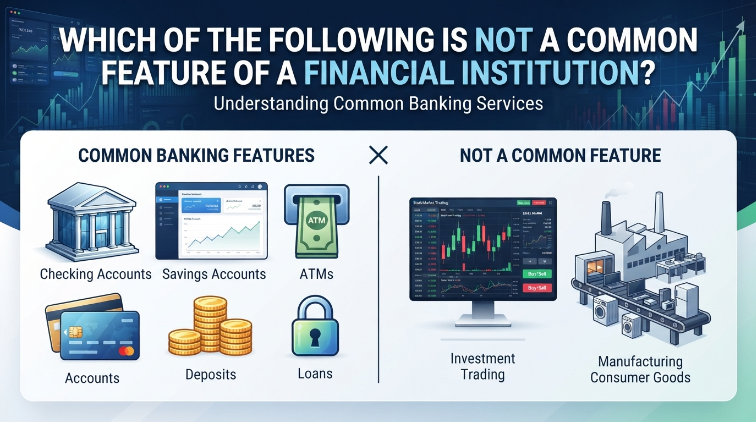

Financial institutions play a central role in everyday money management, but not every financial service or business activity belongs to a traditional bank or credit union. When answering the question “which of the following is not a common feature of a financial institution?”, the key is to distinguish core banking services from specialized activities or services unrelated to finance.
In standard financial literacy questions, access to investment products or investment trading may be the intended answer when the choices focus on basic retail banking features. However, the exact answer depends on the options provided because some banks do offer investment services. Activities such as manufacturing consumer goods are much more clearly outside the normal function of a financial institution.
| Key Point | Typical Answer |
|---|---|
| Common accounts | Checking and savings accounts |
| Everyday access | ATMs and debit cards |
| Deposit services | Accepting customer deposits |
| Credit services | Providing loans |
| Possible exception | Investment trading |
| Clearly unrelated activity | Manufacturing consumer goods |
What Is a Financial Institution?
A financial institution is an organization that provides financial services to individuals, businesses, governments, or other organizations. Banks and credit unions are among the most familiar examples, but the broader financial system also includes investment firms, insurance companies, payment providers, and other specialized organizations.
Traditional consumer financial institutions commonly help customers:
- Deposit and withdraw money
- Manage checking and savings accounts
- Make electronic payments
- Receive direct deposits
- Use debit cards and ATMs
- Borrow money through loans or credit products
- Transfer funds between accounts
These functions support basic money management and are closely associated with everyday banking.
Banks and Credit Unions
Banks generally operate as commercial financial institutions, while credit unions are member-focused financial cooperatives. Their structures differ, but both can provide many similar consumer services, including deposit accounts, payment services, ATM access, and lending.
The exact services available vary by institution. This distinction matters when answering multiple-choice questions because a service may exist somewhere within the broader financial industry without being a standard feature of basic banking.
Common Features of Traditional Financial Institutions
The easiest way to solve this type of question is to identify services that directly involve managing money.
Checking and Savings Accounts
Checking accounts are designed for frequent transactions such as purchases, bill payments, withdrawals, and transfers. Savings accounts are generally intended for setting aside money while maintaining access to the funds.
These accounts are among the most recognizable features of consumer banking.
ATMs and Debit Cards
Automated teller machines allow customers to withdraw cash, check balances, and sometimes deposit funds. Debit cards connect directly to eligible accounts and can be used for purchases and cash withdrawals.
ATM and debit-card access is therefore a strong indicator of a conventional banking service.
Direct Deposit and Electronic Transfers
Many financial institutions allow employers or other organizations to send money electronically into a customer’s account. Customers may also transfer funds between accounts or send payments electronically.
These services have become a normal part of modern personal banking.
Deposits and Loans
Accepting deposits and providing credit are fundamental banking activities. Customers place money into accounts, while qualified borrowers may receive financing for personal, household, educational, or business purposes.
The institution manages these financial relationships as part of its broader role in the financial system.
Which Feature Is Not Common?
The phrase “which of the following is not a common feature of a financial institution?” cannot be answered with absolute certainty without seeing the choices. Different educational materials can use different answer sets.
If the options include access to investment products or investment trading, that may be the expected answer in a basic financial-literacy exercise. Investment services are often associated more directly with brokerage firms and investment companies than with the basic functions of a traditional retail bank.
However, this distinction should not be taken too literally.
Why Investment Services Can Be Confusing
Some banks provide investment accounts, securities services, wealth-management assistance, or brokerage access. Therefore, saying that investment products are never offered by banks would be inaccurate.
The better distinction is between core banking functions and specialized investment services.
For a basic banking question, checking accounts, savings accounts, ATMs, deposits, and loans are more representative of standard consumer banking than securities trading.
Activities That Clearly Fall Outside Banking
Some answer choices are much easier to identify because they have little connection to financial services.
Manufacturing Consumer Goods
Manufacturing physical products is not a normal function of a financial institution. A manufacturer produces tangible goods, while a bank primarily manages money, deposits, payments, credit, and related financial services.
If a multiple-choice question lists “manufacturing consumer goods” alongside banking services, it is usually the clearest example of an activity that does not belong.
Providing Educational Services
Educational services are also outside the ordinary purpose of a traditional financial institution. A bank may provide customers with financial education, budgeting resources, or informational materials, but operating as an educational institution is not its primary function.
This distinction is important because a financial institution can support education without actually being an education provider.
How to Approach a Multiple-Choice Question
When faced with this question on a test, avoid choosing an answer based only on whether the service exists somewhere in the financial industry.
Instead, examine what the question means by “common feature.”
Use These Clues
Ask yourself:
- Is the activity directly related to managing money?
- Is it normally offered by consumer banks or credit unions?
- Does it involve deposits, payments, accounts, ATMs, or lending?
- Is it a specialized service normally associated with another type of company?
- Is the activity completely unrelated to financial services?
The strongest answer is generally the option that falls furthest outside ordinary financial-institution operations.
Financial Institutions vs. Other Organizations
Understanding the difference between institutions makes these questions easier.
| Organization Type | Primary Function |
|---|---|
| Commercial bank | Deposits, payments, lending, banking services |
| Credit union | Member-focused deposits, payments, and lending |
| Brokerage firm | Investment and securities services |
| Investment company | Managing or providing investment products |
| Manufacturer | Producing physical goods |
| Educational organization | Providing structured education and instruction |
These categories can overlap in some areas. For example, a bank may offer investment-related services through a separate division or affiliated company. Still, the primary function of a traditional retail bank remains financial account and payment management, deposits, and lending.
Why the Exact Options Matter
The wording of a multiple-choice question can significantly affect the correct response. “Which of the following is not a common feature of a financial institution?” is incomplete without the answer choices.
For example, if the choices are:
- Checking accounts
- Access to ATMs
- Savings accounts
- Manufacturing consumer goods
then manufacturing consumer goods is the obvious answer.
If the choices are:
- Paper checks
- Direct deposit
- Savings accounts
- Investment trading
then investment trading may be the intended answer in a basic banking lesson.
The distinction comes from the educational context rather than a universal rule that investment services can never be connected with banks.
The Bottom Line
The question “which of the following is not a common feature of a financial institution?” tests whether you understand the basic role of financial institutions. Traditional banks and credit unions commonly provide checking and savings accounts, deposit services, ATM access, payment tools, direct deposit, and lending.
Investment trading or access to investment products may be the intended answer in basic financial-literacy material when it appears alongside core banking functions. However, investment services can be offered by some banks, so the answer depends on the choices and context.
If an option describes manufacturing consumer goods or another activity unrelated to financial services, that is generally an even clearer example of something that is not a common feature of a financial institution.
FAQs
What are common features of a financial institution?
Common features include checking and savings accounts, deposits, withdrawals, ATMs, debit cards, electronic transfers, payment services, and lending.
Is investment trading a feature of a bank?
Some banks offer investment or brokerage services, but investment trading is not necessarily considered a core feature of basic retail banking.
Is manufacturing consumer goods a financial service?
No. Manufacturing produces physical products and is fundamentally different from the financial services provided by banks and other financial institutions.
Why do multiple-choice answers vary?
Different courses and textbooks define the scope of a financial institution differently. The exact answer should therefore be selected based on the choices and the context of the question.
What is the safest way to answer this question?
Compare each option with the basic functions of a traditional bank or credit union. The choice that is least connected to deposits, payments, accounts, lending, or financial management is usually the best answer.

Asad writes about the things that move the world forward — and the people brave enough to build them. Specializing in tech, business, news, and lifestyle content, he’s spent years turning complicated industries into compelling stories for magazines, digital platforms, and brand publications.
He believes great writing doesn’t just inform — it connects. That’s why editors keep coming back: he has a knack for making a SaaS deep-dive feel as gripping as a profile in GQ and a lifestyle feature read with the precision of The Economist.
He currently lives on strong Wi-Fi and stronger opinions about typography.